 |
|
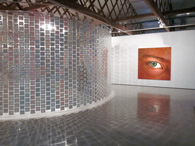
labels (cape), goodman gallery, 2011
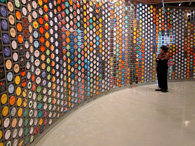
labels (cape), goodman gallery, 2011
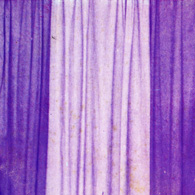
raj, goodman gallery, 2011
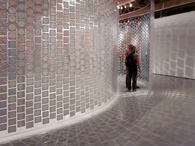
labels (cape), goodman gallery, 2011
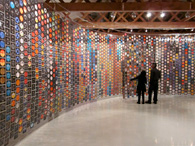
labels (cape), goodman gallery, 2011
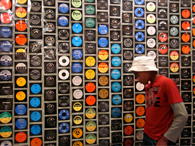
labels (cape), goodman gallery, 2011
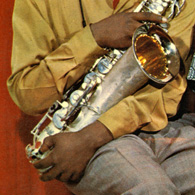
reggie, goodman gallery, 2011
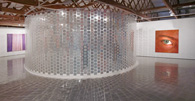
labels (cape), goodman gallery, 2011
|
RECORDS
SOLO EXHIBITION
Goodman Gallery, Cape Town, 2011
September 17 - October 22, 2011
For the past ten years Siemon Allen has been exploring the image of South Africa through a series of collection projects. His studio practice has evolved out of an interest in how mass-produced items – newspapers, stamps, magazines, records – function as carriers of information and operate in the construction of national identity.
Allen’s most recent collection project, Records, is rooted in an extensive archive of South African audio consisting of over 2500 items including 650 rare shellac discs. The project has generated a series of varied works sourced from this ongoing audio collection including a number of site responsive installation works, a series of large-scale digital prints, and a searchable web-based database that can be viewed at www.flatinternational.org.
For his first solo show in Cape Town at Goodman Gallery, Allen will present Labels – an architectural site-responsive installation – as well as a new series of prints sourced from the audio archive. Labels functions as an historical record, a chronological discography of select labels from Allen’s archive. It is also a kind of visual memorial to South Africa’s rich musical past in that each label represents an individual recording, paying homage to that past visually by naming every artist in the archive. Some names and recordings are well known, but many more are now forgotten.
In time, names and labels will be added to the curtain, but like an asymptote that never reaches its axis, the collection can never be complete. Inasmuch as the archive can never contain all recordings, the curtain cannot represent all artists. The project is but a fragment of history and the curtain is an impossible attempt to capture that history.
Each label functions as both a tribute to decades of South African music and a memorial to those individuals named. Though Allen’s curtain is more celebratory than somber, like Maya Lin’s Vietnam Veterans Memorial in Washington, D.C, the sheer accumulation of ‘the individual’ transforms the collective into the monumental.
Labels is a site-responsive, architectural installation, a 38 metre long, semi-transparent curtain wall supporting a staggered grid of over 5400 unique images that form a large accessible circular enclosure. Operating as an architectural intervention in the gallery, the work forms a curving gridded wall that meanders through the space. With Labels Allen revisits a theme that has been dominant in his work for many years: the idea of a “space within a space”. The exterior surface of the curtain wall reads as a clean, almost minimalist abstract grid, while the interior becomes a colorful complex pattern of disc shapes with text and markings. Up close one is able to digest the details on each individual label. From afar the textual information begins to lose focus and recede, to be replaced by a tapestry-like colour-field pattern.
The circular structure of the curtain spirals onto itself in such a way that an entrance is created at the point of overlap. Labels are arranged chronologically with the earliest dating from 1901 situated at the opening. As one enters the structure and proceeds through the passageway, the chronology moves forward in time. The visual effect produces in the viewer the experience of being completely enveloped by the labels. As the curtain wall spirals back onto itself it is almost as if the more recent labels – the present – begin to overlap or mask the earlier ones – the past.
Labels has is roots in two installations first shown at Bank Gallery in Durban in 2009. Here Allen exhibited a large grid of digital prints sourced from the labels of Miriam Makeba recordings and a transparent curtain wall displaying record covers inserted to show both front image and back liner notes. For the South African Pavilion at the current 54th Venice Biennale, and in response to the architectural particulars of the Torre di Porta Nuova, Allen constructed a version of Labels that was a 14-metre-tall curtain wall containing 2500 labels. Displayed vertically in a space of enormous height, with a vaulted ceiling and backlit by an arched window, the work resembled a stained-glass window. Labels at Goodman Gallery is more than double the size of the Venice installation. Displayed in a horizontal format and configured to create an accessible interior space, this version also operates as both pattern and place.
The exhibition also features a series of prints sampled from Allen’s music archive. For this new work Allen has scanned minute details, selectively framing fragments of record covers to produce new, sometimes abstract, narratives. This selective framing shifts the images in the prints from their original sources as promotional shots to cinematic moments – sometimes becoming almost painterly.
The four large prints in the series, Santa (the eye), Raj (the purple curtain), Reggie (hands holding a saxophone), and Castle (the crowd) become moments or stations in the exhibition that map a sequence of how one might approach the installation. The eye, the viewer, the stage-curtain, the performer, the audience: all become meditations on performing, exhibiting and viewing.
The detailed scans of the record covers also reveal the language of the original printing process. From afar they appear as readable images, but up close the images dissolve into the abstract grid of the halftone CMYK dot system. The digital images are each printed with Epson HDR ink on Hahnemühle Museum Etching Fine Art paper and mounted on Dibond.
|
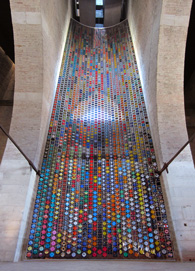
label (venice), 54th venice biennale, 2011
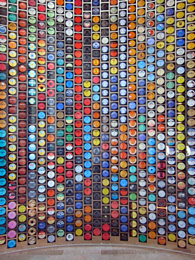
label (venice), 54th venice biennale, 2011
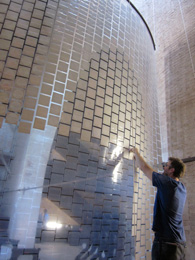
label (venice), 54th venice biennale, 2011
|
curated by Thembinkosi Goniwe
May 1 - November 27, 2011
Artists: Siemon Allen, Lyndi Sales and Mary Sibande
Commissioner: Monna Mokoena
Desire: Ideal Narratives in Contemporary South Africa Art marks the democratic South Africa’s debut in the 54th Venice Biennale. Since her ascent to the membership of nations with constitutional democracies, South Africa has emerged as a symbol of how best to usher in freedom from the ashes of bondage. Desire features the work of three South African artists, Siemon Allen, Lyndi Sales and Mary Sibande, who all richly explore a range of realities, memories and fantasies. They produce imaginary truths or rather ideal narratives that reflect on South Africa, and how this democratic country has successfully transcended its past history to foster human values of equality, respect and dignity.
Siemon Allen, for the past 8 years has been exploring the image of South Africa through a series of collection projects. The most current collection, an archive of South African audio, is made up of over 2800 items including 650 rare 78rpm shellac discs. For the 54th Biennale, Allen will be presenting Records, a selection of large-scale digital prints and Labels, a new site responsive installation made for the exhibition.
Records is a series of large format prints on Hahnemühle Museum Etching paper selected and scanned from the larger audio collection. The scans of the records produce remarkable detail capturing not only the grooves but also the accumulated historic traces of scratches and damage that speak to the memory of the object. Labels is comprised of 2565 records labels and measures over 12 meters high. It is a site responsive work conversing with the soaring ceiling of the Torre di Porta Nuova. For more information about the project go to: www.flatinternational.org
In these artist’s works, post-apartheid South Africa is a site to explore ideals of beauty, pleasure, democracy, and freedom. Whether working inside or outside of South Africa, these artists explore conditions that give rise to lack of and longing for personal and societal freedom: to desire.
With the support of:
Department of Arts and Culture, Republic of South Africa
South African Embassy Rome
South African Consulate General, Milano
*excerpt from the press release
|
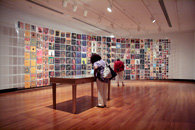
makeba!, krannert gallery, 2011
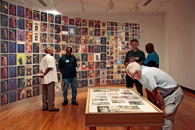
makeba!, krannert museum, 2011
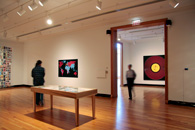
makeba!, krannert museum, 2011
|
MAKEBA!
Krannert Museum, Urbana-Champaign, Illinois, 2011
curated by Tumelo Mosaka
August 26 - December 30, 2011
South African singer Miriam Makeba also known as Mama Africa, popularized Africa music around the globe long before the phrase “world music” was coined. Her musical style fused American Jazz with African sounds to create a new musical language that explored the black South African experience under apartheid. Artist Siemon Allen has collected recordings by Makeba along with artifacts from the larger history of South African music. Given that her outspoken critique against apartheid, forced her into 30yrs of exile, Makeba dedicated her life and music to the struggle against apartheid. The exhibition explores the global movements of Makeba’s music and image while mapping the political landscape of South Africa under apartheid.
*excerpt from wall text
|
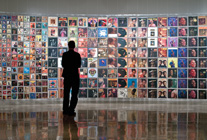
makeba!, anderson gallery, 2010
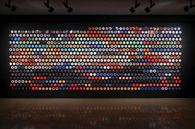
labels, anderson galley, 2010
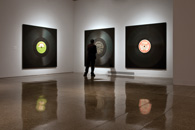
records
, anderson gallery, 2010
|
curated by Ashley Kistler
August 27 - October 31, 2010
Spanning all three floors of the gallery, this exhibition offered the most comprehensive presentation to date of South African artist Siemon Allen’s “collection projects.” Over the last decade, Allen has created expansive installations of various mass-produced ephemera—postal stamps, newspapers, audio recordings—that he has methodically acquired and catalogued. In terms of process, he approaches each project like an archivist, researching and assembling artifacts to disclose underlying narratives about their production, dissemination, use, and message. Allen employs the social critique that inevitably arises from his work as a means of interrogating what he describes as “the contradictory and complex nature of South African identity.”
With Records, the most recent addition to the series, Allen has built an extensive ongoing collection of South African music and audio artifacts, with the intention of establishing a web-based archive of this material, [now online at www.flatinternational.org]. Allen began assembling Records three years ago when he purchased a 1965 record by the exiled South African singer Miriam Makeba. Struck by the overtly political nature of the album cover’s liner notes, he began to investigate how these artifacts disseminated an anti-apartheid message. Allen has now acquired over 400 recordings by Makeba that reveal the global reach of her image and music. This project is only one part of a much larger collection of South African audio material. Allen will also show a new series of monumental prints created from scans of individual records culled from his larger collection. When magnified in images nearly seven feet square, their distressed, topographic vinyl surfaces visually capture veritable histories of repeated use
|
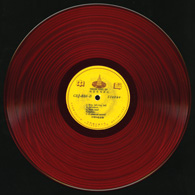
mirian make ba , vmfa, 2010
|
MIRIAN MAKE BA
presented in conjunction with the exhibit
Virginia Museum of Fine Art, Richmond, VA, 2010
curated by Tosha Grantham
August 21 - October 24, 2010
This ground-breaking exhibition featured the work of 18 photographers and video artists who have lived and worked in South Africa, both during the apartheid era (1948–94) and beyond. Darkroom was presented by the Virginia Museum of Fine Arts in conjunction with the Visual Arts Center of Richmond. A companion exhibition Imaging South Africa by contemporary South African artist Siemon Allen was presented at the Anderson Gallery at Virginia Commonwealth University.
Tosha Grantham the curator of Darkrooms invited Allen to show Miriam Make Ba(a large 78" x 78" print of a red vinyl record)
at the entrance to the exhibition as a way to tie the two companion shows together.
|
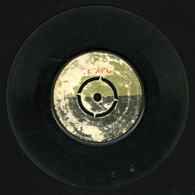
records, jaf, johannesburg, 2010
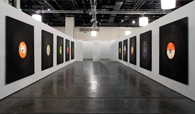
records, jaf, johannesburg, 2010
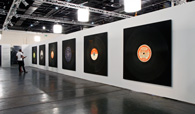
records, jaf, johannesburg, 2010
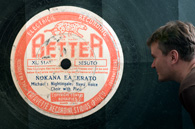
better, detail, bank gallery, durban, 2009
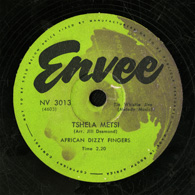
envee , jaf, johannesburg, 2010
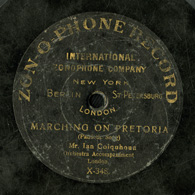
zon-o-phone , jaf, johannesburg, 2010
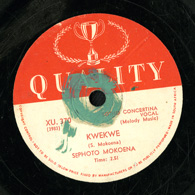
quality , jaf, johannesburg, 2010
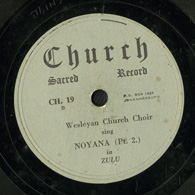
church , jaf, johannesburg, 2010
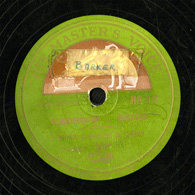
his master's voice, jaf, johannesburg, 2010
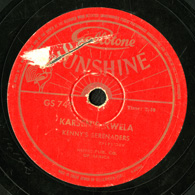
sunshine, jaf, johannesburg, 2010
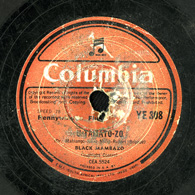
columbia, jaf, johannesburg, 2010
|
March 26 - 28, 2010
Presented by the gordonschachatcollection.
In 2009 I was commisioned by the gordonschachatcollection to produce a set of large-scale prints of records from my collection of South African audio. The set is an extension of the three record prints I had already shown at the BANK Gallery earlier that year. Later the GSC invited me to present the print set at the 2010 Johannesburg Art Fair. The text below accompanies the Art Fair catalogue.
[From the catalague text:]
The act of archiving is never objective, never neutral. Every collection is the result of selection and framing. In examining a collection of artifacts we consider not only the nature of what is being collected, but also who is doing the collecting and with what organizing systems. Every object in an archive is but a fragment of an incomplete history, and in examining the imagery in a given body of collected material we look at what is explicitly shown, but we also acknowledge what is not. Plucked from one context to be placed into another, the collected artifact is a carrier of information scarred by use.
South African born, US based, artist Siemon Allen for the past eight years has been engaged in a massive collection project called Imaging South Africa. In his studio practice Allen systematically accumulates mass-produced printed material, including postal stamps, newspapers, and most recently audio recordings, which he ultimately catalogues, displays or uses as source material. His process is not unlike that of an archivist, each collected item bringing with it a narrative particular to the nature of that artifact’s production, dissemination, and use. And yet, arranged for exhibition, items in Allen’s collection projects are typically configured in such a way as to also operate as pattern fields.
The seeds of these collection projects were a series of intimate pieces shown at the Institute of Contemporary Art (ICA) in Johannesburg in 1993. Intentionally narrow in scope they were simple displays of personal possessions from Allen’s youth presented like specimens, and included a set of Hardy Boys books, a pair of Doc Martens shoes, and his boyhood stamp collection. Allen regarded the items as tagged evidence, markers of particular identities over time. In the work he presented a kind of archive from a narrowly inscribed South African culture as experienced through the lens of his own limited individual experience.
With Elegy and Stamp Collection the scope of the works expanded and the focus moved from ‘self’ to ‘nation.’ Elegy, the first major woven videotape installation was built in the US in 1996 and titled to reference Paul Stopforth’s painting of Steve Biko of the same name. To Allen it was significant that the source image for Stopforth’s painting was a censored photographic document and that the imagery and sound on his woven videotape was inaccessible. In 1997, Elegy was reformatted into the large-scale installation La Jetee for the 1997 2nd Johannesburg Biennale as part of the Graft exhibition curated by Colin Richards at the South African National Gallery.
Stamp Collection, an ongoing collection of South African stamps from 1910 to the most current releases was displayed in a variety of ways including linear time lines and massive grids. The first showing of the work in 2001 was a solo exhibition at The Corcoran Gallery in Washington, DC. Later included in Detourism, a group exhibition curated by Hamza Walker at The Renaissance Society in Chicago, and Context and Conceptualism curated by Lauri Firstenberg for Artists Space in New York City, the collection featured approximately 8000 stamps. By the time that Allen presented the work in South Africa in 2009 at the Durban Art Gallery the collection had expanded to over 45,000 individual stamps. For Allen, these artifacts reflect the way in which a government defines or images itself. This most conventional of collected items operates not just as a philatelic project, but a record of South Africa’s “internally constructed image” over time.
In Newspapers, another ongoing archive project, Allen examined how South Africa was represented in the US media by investigating what he regarded as the country’s “externally constructed image.” Over a given period of time Allen purchased daily newspapers from several US cities including The New York Times, The Washington Post, The Washington Times, The St. Louis Post Dispatch, and The Des Moines Register. For display, the newspapers were pinned onto floor-to-ceiling panels, each newspaper covered by a thin sheet of tracing paper that resulted in a semi-transparent overlay. Windows were cut to reveal the paragraphs mentioning South Africa. From across the room, the work appeared as a large grid with subtle shifts of grey and small patches of color. Up close the content of the articles were easily accessed. Here as in Stamp Collection artifact display conversed with geometric abstraction.
Like Stamp Collection, Newspapers was exhibited in a number of venues in various configurations and with subtle shifts in meaning. For a show in 2002 at Fusebox Gallery in Washington, DC, Allen presented The Washington Post and The Washington Times on opposing walls. Other versions of Newspapers were created from the newspapers particular to a given city, and portions of the collection were included in The American Effect, curated by Larry Rinder at The Whitney Museum of American Art in New York City and A Fiction of Authenticity, curated by Shannon Fitzgerald and Tumelo Mosaka at the Contemporary Art Museum St. Louis.
Records, the most current of the collection works, is Allen’s immense and growing accumulation of South African audio material. This ongoing project currently consists of over 2000 items including 500 rare 78 rpm shellac discs and has evolved into a searchable web-based audio resource.
The record collection grew out of a project called Makeba!, an almost comprehensive inventory of international recordings by South African singer and political activist, Miriam Makeba. It all began with a single Makeba LP dating back to 1965. Upon finding the LP and reading the liner notes, Allen had been struck by the political nature of the text and had wondered how the record had functioned in the dissemination of the anti-apartheid message. He asked himself how these commodities, mass-produced for entertainment in the Americas and Europe had operated in creating a global awareness of apartheid in South Africa. As the collection grew the project evolved into an investigation of the particular global reach of the exiled singers music and image; and a recognition of the subtle differences in how each country imaged Miriam Makeba, Apartheid, and South Africa.
The project soon expanded to include early South African music as well as other audio artifacts from South Africa and Allen’s increasing focus on relatively rare and unusual material led him to used, often severely worn, 78 rpm records. These artifacts became the source material for his most recent body of work, a series of iconic large-scale digital prints that are direct scans of records from the collection.
Printed in rich matte tones on velvet archival paper the scans offer remarkable detail capturing not only the grooves that are the (here mute) carriers of the sound, but also the accumulated grime, scratches, damage, and repair work done by the records’ owners. These original manufactured grooves and subsequent random cuts and scuffs both operate as markings. What is a destroyed or distressed surface, the result of multiple playings and damage, becomes an expressionistic drawing; the visible markings on the record’s surface a function of its use and a trace of its history.
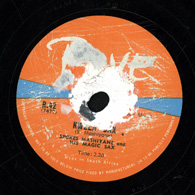
Unlike the collector who values the mint-condition artifact, Allen regards the damage on the record as a kind of participation by subsequent anonymous authors, collaborators who have unwittingly altered the original recorded sound and in doing so contributed their own history to the object. The obvious wear on such audio artifacts speaks to a degradation of the original sound, and yet the damage on most of the records in the collection are the result of use and re-use. For Allen, such damage is evidence of the recorded musician and the listener’s mutual relationship. In Rave, for example the white painterly marks around the hole of the label is a Plaster-of-Paris fill probably made by one of the record’s owners, a center hole recreated after that centre had deteriorated so dramatically from use. The repair job shows—as messy as it looks—a persistence to keep the record grooving.
In a sense, the scans of records from Allen’s collection are both part of his audio archive and something quite apart. Allen says “ I think about how I have now taken an original artifact, a 78 rpm record, which is itself a document of an original performed audio moment, and transformed it into an image. That image becomes a new object where the audio trace is now twice removed from its original breath.”
Indeed it is significant that though these prints are considered by Allen to be part of his audio collection and speak to the primacy of music in South African cultural history, they are silent. Wear and repair, like the plastered hole on Rave, identify the record as an object independent of its sound carrying capacity. Allen’s videotape works denied the viewer the sights and sounds of the video recording, but offered a sleek reflection. Perhaps the luscious velvety surface of the Records prints operates in a similar way, bringing one in, making one want to touch, or connect to this new object, transforming the auditory to the visual and tactile.
Kendall Buster
Professor
Department of Sculpture + Extended Media
Virginia Commonwealth University
|
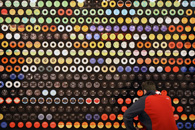
labels, bank gallery, durban, 2009
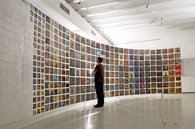
covers, bank gallery, durban, 2009
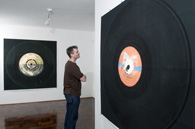
large prints at bank gallery, durban, 2009
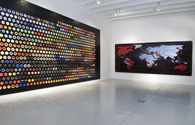
labels & map, bank gallery, durban, 2009
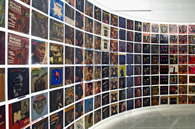
coversl, bank gallery, durban, 2009
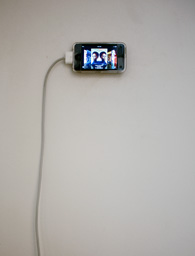
ipod, bank gallery, durban, 2009
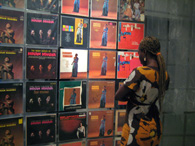
covers, bank gallery, durban, 2009
map, bank gallery, durban, 2009
|
Makeba!, 2006-2009 (Covers, Labels, Map and iPod)
Better, 2009
Tempo, 2009
Rave, 2009
[From the exhibition wall text.]
The works in this exhibition are all part of a larger body of work called Records, the third of Allen’s Imaging South Africa collection projects.
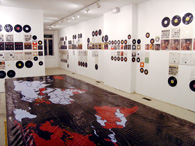
Records began in Richmond, Virginia three years ago when Allen was sifting through used records at a thrift store and came across the LP “An Evening with Belafonte/Makeba.” Reading the liner notes on the back of the album and seeing that the release dated from 1965 he was struck by the significance of the political message carried in the text and how Makeba, a South African singer, had spent most of her career working outside of her home country. Allen began to consider how such cultural commodities, mass-produced outside the country, had operated in imaging South Africa for a global musical audience. This resulted in Allen’s intensive collecting of recordings from the long and prolific career of the South African singer Miriam Makeba and the accumulation of artifacts from the larger history of South African music. Assembled chronologically the Makeba records reflect the singer’s changing portrait over time and the expanding global reach of her message.
COVERS, 2009
LP, EP, CD covers, Clear-Lay PVC film, poly sleeves, aluminium, tape
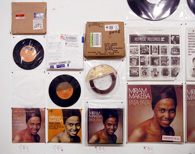
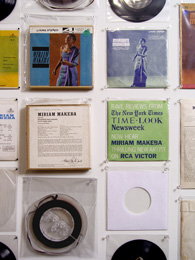
Record covers and CD inserts are configured in a grid to show how packaging for releases from different countries of similar audio material often varied with only subtle differences in design and palette. On the reverse side, the text revealed a significant range of political content. Potentially controversial information was edited out in some countries and foregrounded in others. Arranged as multiple portraits the covers also assert Miriam Makeba’s iconic image.
LABELS, 2009
Inkjet photo-prints, black plastic, map-pins
Photographs of the record labels from each item in Allen’s Makeba collection including 78 rpms, 45 rpms, LPs, reel-to-reel tapes and CDs.
MAP, 2009
Marker pen on clear plastic, moving blankets, map pins
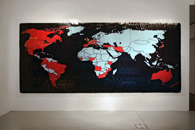
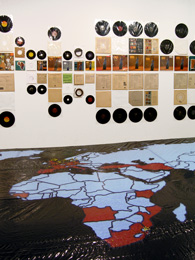
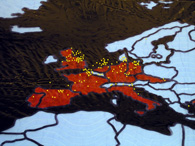
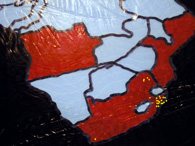
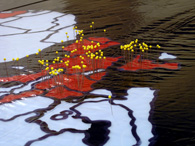
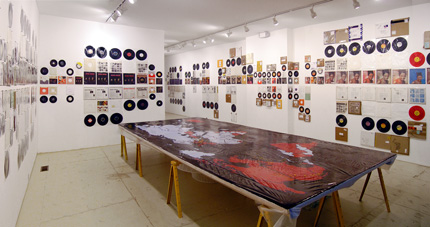
The Makeba recordcollection was assembled from sources all over the world, many through the web marketplace of eBay. Countries that manufactured records in the collection are indicated as red. Cites where recordings were acquired are marked with a yellow point. Map is an index of the global movements of Makeba’s voice.
IPOD, 2009
iPod mp3 player
The iPod contains at least one version of every song in the collection.
Viewers are invited to iscroll through the mp3 archive and choose any song to play in the gallery. Unlike a jukebox play can be interrupted by chosing another song.
BETTER, TEMPO, RAVE, 2009
Epson K3 archival ink on Epson Velvet Fine Art Paper, archival tape
80" x 80" or 203 cm x 203 cm
Gordon Schachat Collection
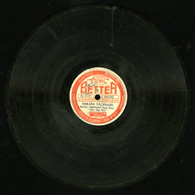
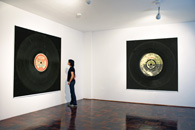
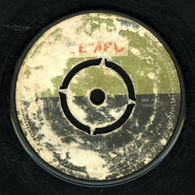
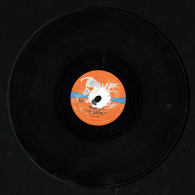
These large-scale digital prints are direct scans of records from Allen’s larger South African record collection. As in many of his previous works the vehicle is rendered mute, the record considered as material rather than a carrier of sound. The extreme enlargement reveals the record for what it is – a history of scratches and grooves. Wear and repair (such as the plastered hole in Rave) speak to the record as an object independent of its sound carrying capacity.
What appears to be a destroyed or distressed surface - a result of multiple playings - becomes an expressionistic drawing. The visible markings on the vinyl’s surface are a function of its use and a record of its history. Ironically, such obvious wear to a collector might indicate diminished value, but here it is a document of the pleasure it has brought.
VIEW MORE INFORMATION ABOUT THIS EXHIBITION HERE
|
better, bank gallery, durban, 2009
large prints at bank gallery, durban, 2009
tempo, detail, bank gallery, durban, 2009
rave, detail, bank gallery, durban, 2009
ravel, bank gallery, durban, 2009
tempo, bank gallery, durban, 2009
tempo, flatinternational, richmond, 2009
|
NOTES ON THE LARGE PRINTS
Better, Tempo, Rave, 2009
Epson K3 archival ink on Epson Velvet Fine Art Paper, archival tape
80" x 80" or 203 cm x 203 cm
Gordon Schachat Collection
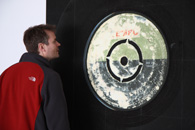
In the room adjacent to the Makeba! installation at the Bank Gallery in Durban, I set up three large-scale prints that formed part of a new body of work that developed out of the Makeba! project. As this first project progressed I found myself slowly expanding the limits of the collection to include any audio artifact from South Africa—jazz, punk, plays, political speeches, sports commentary, etc. My focus was on relatively rare and unusual material and included recordings in early formats such as 78 rpm. My ultimate goal for this ongoing archive is to document all the information and to eventually make it available as a searchable database on the web. The large prints on exhibition—Better, Rave and Tempo—come from this archive. They do not represent the archive in full but rather are extractions from it.
Practically, these prints are detailed scanned enlargements of individual records. I chose items that were particularly damaged, scratched or stressed; perhaps the opposite of what a record collector might prefer to collect. The damage on the record was a further marking by unknown authors who had unwittingly contributed their history to the object. The image in the print captures not only the historical audio visually in the form of the lines or grooves, but also the scratches, damage, and repair work done by subsequent owners, which is clearly visible.
For me, the damage shown in the prints sets up a visual irony. On one hand, in art historical terms, it represents a kind of decay or even degradation. On the other hand, the damage is, in most cases, the direct result of use and reuse. It could be viewed as the by-product of the most amazing fun. This irony is heightened when one considers the context of the object’s use—the apartheid era.
In the image Rave, the white area around the hole of the label is a Plaster-of-Paris fill done by one of the record’s owners. The owner had re-created the centre after it had deteriorated so dramatically. As messy as this looks, the repair job here shows a persistence to keep this record grooving.
Kwela Sax, the title of the repaired record in the Rave print has its own unique history. Spokes Mashiyane, its author, is credited as having popularized kwela or pennywhistle jive with his recordings Ace Blues and Kwela Spokes in 1954. Over the next four years he would remain one of the most famous and prolific proponents of this musical style.
The name kwela itself, loosely translated as “step up”, refers to apartheid-era police vehicles. When people were arrested the policemen would order them to “step up” into the vehicle. In the introduction to the famous 1956 track, Tom Hark, by Elias Lerole and his Zig Zag Jive Flutes, one can hear a street-gang gambling over an illegal game of dice. One of the individuals shouts out in tsotsitaal—an Afrikaans derived street-slang—“Hier kom die kwela-kwela! Stop […] want hulle gaan ons bo vat!” (Here comes the kwela-kwela! Stop […] otherwise they’re going to take us away.) Some have said that it may have been white consumers of the music hearing the word “kwela” in this introduction that then applied it to the style of music. Though clearly the word “kwela”, sometimes spelled “quela”, can be found in the titles of tracks recorded many years prior to Tom Hark.
Kwela Sax, recorded in 1958, is the b-side of Big Joe Special and the record marks the first time that Spokes Mashiyane played on saxophone. As with his earlier Ace Blues, Big Joe Special was a sales phenomenon. The record became the trendsetting hit of that year and would inspire a whole new style of music. Sax jive—latter called mbaqanga—would dominate South African urban music for the next twenty years.
Spokes Mashiyane, after his successes with Trutone Records and their Quality and Rave labels, was lured away by Gallo Records in 1958. At Gallo he became the first black musician to receive royalties from his recordings.
Siemon Allen, 2009
VIEW MORE INFORMATION ABOUT THIS EXHIBITION HERE
|
makeba!, in process, richmond, 2007
makeba!, in process, richmond, 2007
makeba!, in process, richmond, 2007
makeba!, in process, richmond, 2007
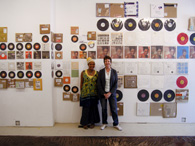
sue williamson & tosha grantham, richmond
makeba!, in process, richmond, 2007
makeba!, in process, richmond, 2007
makeba!, in process, richmond, 2007
makeba!, in process, richmond, 2007
makeba!, in process, richmond, 2007
|
MAKEBA!
flatinternational, Richmond, VA, USA
In process, 2006 - 2007
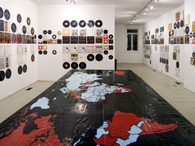
Makeba! is the third collection project in the series Imaging South Africa. This project, which is ongoing, currently includes over 400 individually collected audio recordings by the South African singer and anti-apartheid activist, Miriam Makeba. These include 78 rpm discs, vinyl records, singles, 4-track reel-to-reel tapes, 8-track cartridges, cassette tapes, compact discs, and a number of other rare items such as a steel and acetate demo recording.
The project developed through an extensive search that ultimately led me to the international market—eBay. Built in two years of sifting through internet auctions—bidding and sniping, winning, sometimes loosing, sending and receiving thousands of emails—the recordings were collected from all over the world. In the process the project has thus far allowed me to communicate with people from countries such as Turkey, Japan, Sweden, Israel, New Zealand and Brazil amongst others—all linked by a common interest in the music of Miriam Makeba.
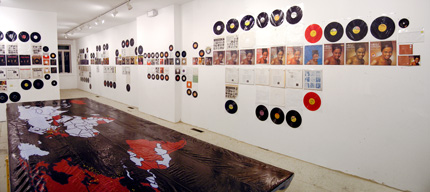
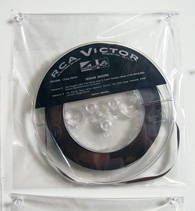
My interest in these particular recorded artifacts is not limited to the audio material, as I am equally invested in exploring how the material containing these recordings also operates to convey information. Not only is the design of the album sleeve or insert important to the project, but also the unique packaging that each of the sellers has used to wrap and mail the materials. To this end, in a number of displays of the collection, I have included along with what I regard as the carrier of the audio information – the vinyl, the tape, the compact disc, the manufacturer’s packaging and shipping material.
The result is a grid that in sections shows identical mass-produced images of Makeba; “portraits” that vary slightly from individual wear and printing; photographs that began from the same negative transformed from design to design.
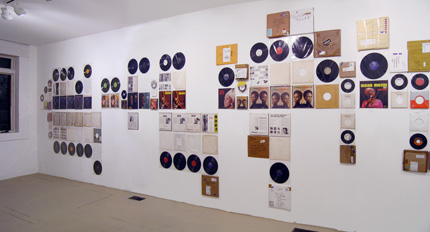
The project is still evolving, but the current version shown here includes a large map of the world with areas colored in red to indicate the country of manufacture for the individual Makeba records; and yellow pins to mark the places from which the particular audio material was purchased.
The Imaging South Africa series grew out of an investigation into the image of South Africa, the first project, Stamps, consisting of over 8000 South African stamps. The second, Newspapers, featured a collection of news coverage about South Africa from various US newspapers. Both of these collection projects developed out of my attempts to look at how the country constructs an image of self and projects it throughout the world and conversly how it is imaged by others such as the international media. In some sense, the stamp project represented an internal construction of image or identity, while the newspaper project revealed an image of place that was externally constructed.
Makeba! is a continuation of these investigations into imaging. The roots of the project go back to a time when I was sifting through records at a thrift store in Richmond, Virginia and came across the LP “An evening with Belafonte/ Makeba.” It was two dollars. Reading the liner notes on the back, I was struck by the very political nature of the text. The album dated from 1965, and I began to wonder about how this record cover operated in the dissemination of the anti-apartheid message. How did these commodities, mass-produced in the Americas and Europe operate in creating awareness about the apartheid problem in South Africa?
I began to rather obsessively collect the records in order to examine and to document the message and the image that Miriam Makeba had communicated to an international audience.
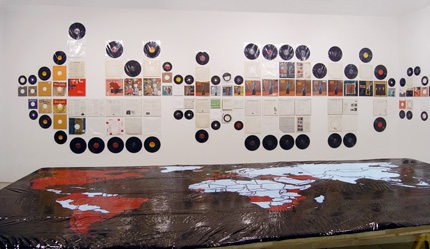
The project pays homage to this artist’s prolific career. Currently set up chronologically, one is able to view the changes in her image over time. Similarly one can see how different countries have chosen to represent her image through subtle shifts in design strategies. In a macro sense, the chronology allows one to also view the shifts in audio recording technologies, moving from 78 rpms, through compact discs all the way to the iPod.
Subsequently the chronology reveals much about the music industry's marketing strategies such as its development of the "world music" moniker. The project re-addresses this "world music" phenomenon in the face of globalisation through its very accumulation process—via ecommerce and global networks such as eBay.
Siemon Allen, 2007
|
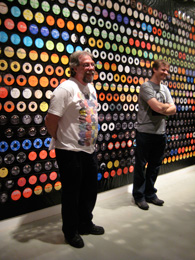
opening by richard haslop, bank gallery 2009
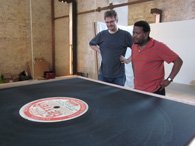 with thembinkosi goniwe, venice, 2011 with thembinkosi goniwe, venice, 2011
|
EXHIBITION HISTORY
IMAGING SOUTH AFRICA: RECORDS|NEWSPAPERS|STAMPS
Records, Labels, Makeba!
With an opening introduction by Richard Haslop
March 3 - April 16, 2009
Bank Gallery, Durban, South Africa
JOBURG ART FAIR 2010 : Featured Artist
Records
presented by the gordonschachatcollection
March 26 - 28, 2010
Johannesburg, South Africa
DARKROOMS: Photography and New Media in South Africa
Mirian Make Ba
curated by Tosha Grantham
August 21 - October 24, 2010
Virginia Museum of Fine Art, Richmond, VA
IMAGING SOUTH AFRICA: Colletion Projects by Siemon Allen
Records, Makeba!, Labels
curated by Ashley Kistler
August 27 - October 31, 2010
Anderson Gallery, Richmond, VA
DESIRE: Ideal Narratives in Contemporary South African Art
54th VENICE BIENNALE - South African Pavilion
Records, Labels (Venice)
curated by Thembinkosi Goniwe
May 1 - November 2011
Venice, Italy
MAKEBA!
Makeba!, Labels, Miran Make Ba, iPod, Map II
curated by Tumelo Mosaka
August 26 - December 30, 2011
Krannert Museum, Urbana-Champaign, Illinois
RECORDS
Labels (Cape Town), Santa, Reggie, Raj, Castle
September 17 - October 22, 2011
Goodman Gallery, Cape Town, South Africa
|
|
|